




Famed for creating large-scale outdoor artworks using paint-filled fire extinguishers, Melbourne artist Ash Keating explains why he’s exploring fresh colours and unconventional settings for his works. Interview by Christian Barker
During the recent Melbourne Art Fair, leading Australian artist Ash Keating held a pop-up exhibition of his latest paintings. The show occupied the same venue in Melbourne’s CBD where Keating first exhibited his signature Gravity System Response technique a decade ago. With the ‘GSR’ method, Keating applies paint using an airless sprayer or pressurised fire extinguishers, then adds water to dilute and manipulate areas of the composition, allowing the paint to blend in a truly fluid manner.
“I’m very particular about the drips,” Keating tells us, on a video call from his studio a few days before his exhibition’s opening, wet paintings glistening in the background. “There are some works where, because of the amount of water I use, the pieces continue to develop by themselves as I work on them. In the latter stages, it’s almost like sculpting with water, using high-pressure jets or fine sprays to break down the paint.” This, Keating says, “creates that ethereal, floating quality you often see in my work.”
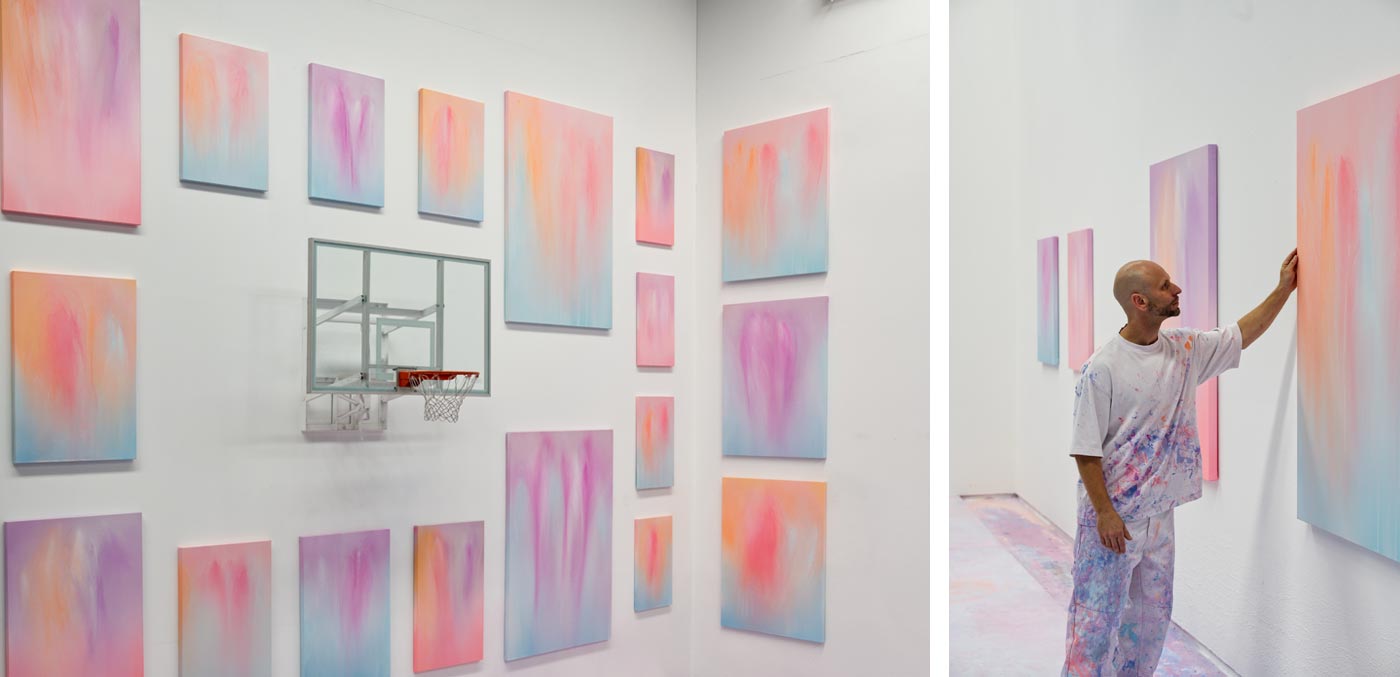
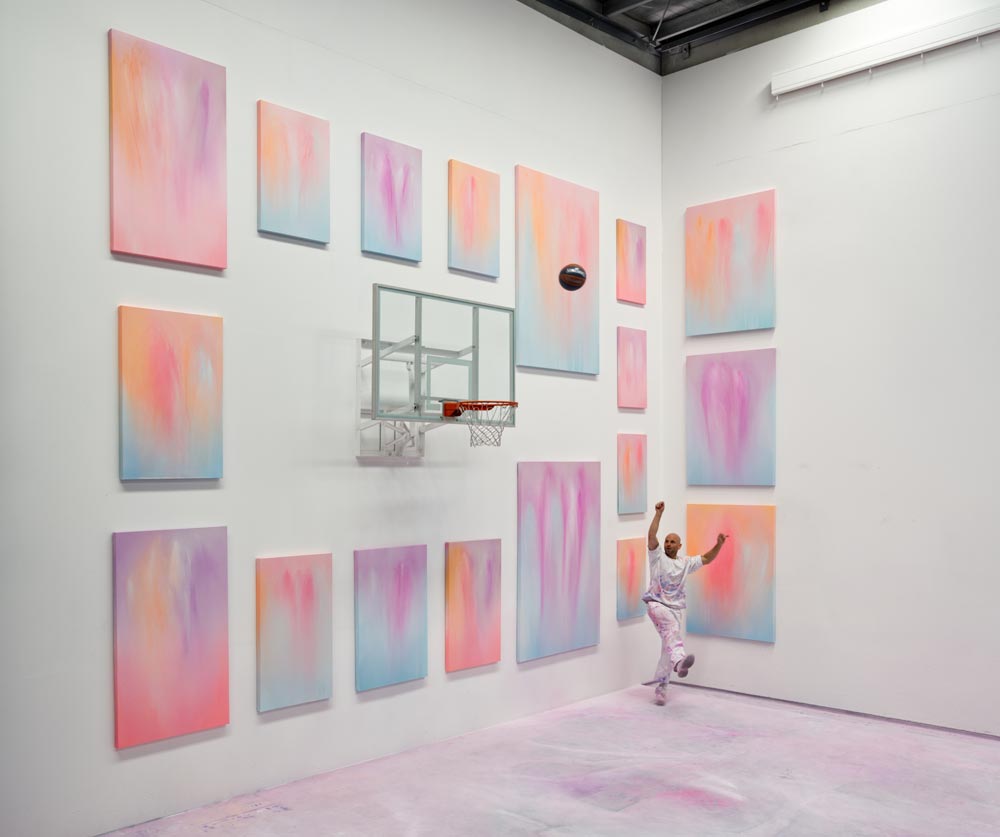
Keating’s most recent works are ethereal indeed, in a delicate palette of pale blue, peach, pink, lavender and lemon. Yet look closely at the canvases, and there’s something visceral – almost fleshy – to the way the colours and textures meld. They’re an exercise in contrasts. The hues are serene and calming. But the viewer can’t help sensing the vigorous, borderline violent action involved in the paintings’ creation.
Graffiti/street art origins
Keating got his start as a street artist, initially painting graffiti characters before evolving toward a more abstract approach, dripping or splashing paint on walls, stabbing spraycans and allowing the released pressure to work its random magic.
“There’s still some of that raw energy in my current work, especially in my outdoor pieces made with extinguishers,” Keating says. “I’ve always appreciated the immediacy and the connection with the public, which started with me working on murals. That’s when I began using water with extinguishers and diluted paint, and I started seeing the beauty of the colours merging on the walls.”
Despite now being a recognised, sought-after contemporary artist who is invited to paint public spaces, rather than having to do so quickly and surreptitiously under the cover of night, the guerilla spirit of his graff period lingers on. “That raw, almost reckless energy of my early days hasn’t disappeared,” Keating says. “There’s still a spontaneity in my work, and it’s connected to how I feel about nature and the laws of physics — things that are bigger than me. I guide the process, but ultimately, the work is more about the broader natural forces at play.”
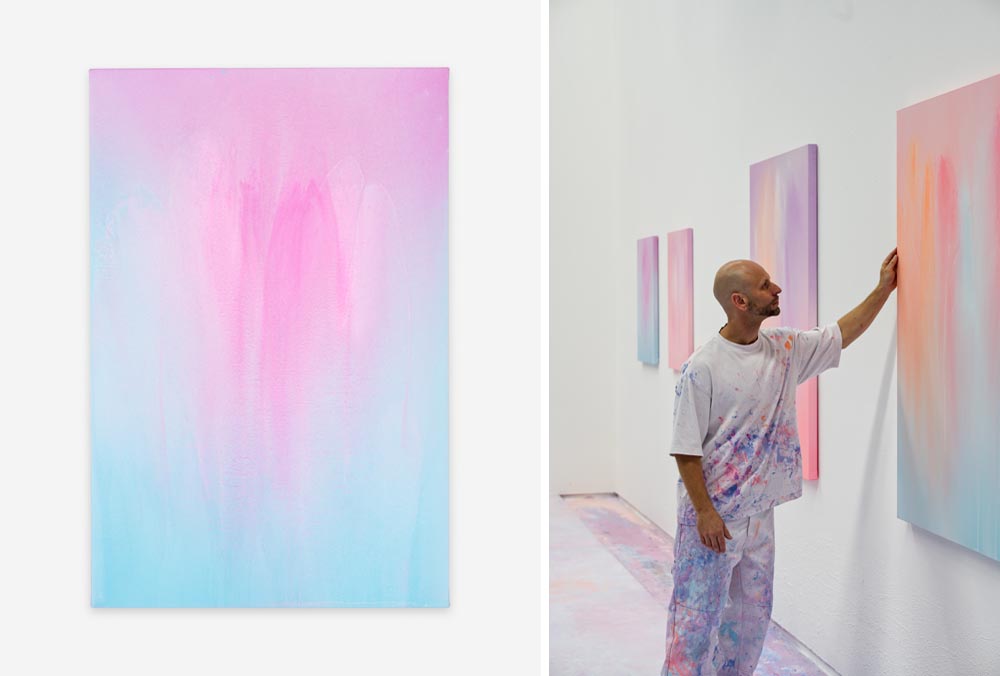
Gravity System Response
The tones of his latest series stand in marked contrast to Keating’s earlier efforts. “Over the years, I’ve really pushed myself to experiment with colour,” he says. “I recently pulled out some of my older works from around 10 years ago, and I was surprised by how bold the colours were back then — bright reds and oranges. They felt soft and medicinal to me at the time, but now I see them as quite bold.”
Currently, Keating says, “I’m drawn to softer, ethereal palettes. There’s something about balancing softness and boldness that fascinates me. I want to create something that has a sense of depth, where colour is almost alive. It’s that fine line between subtlety and intensity that keeps me exploring new possibilities in the studio.”
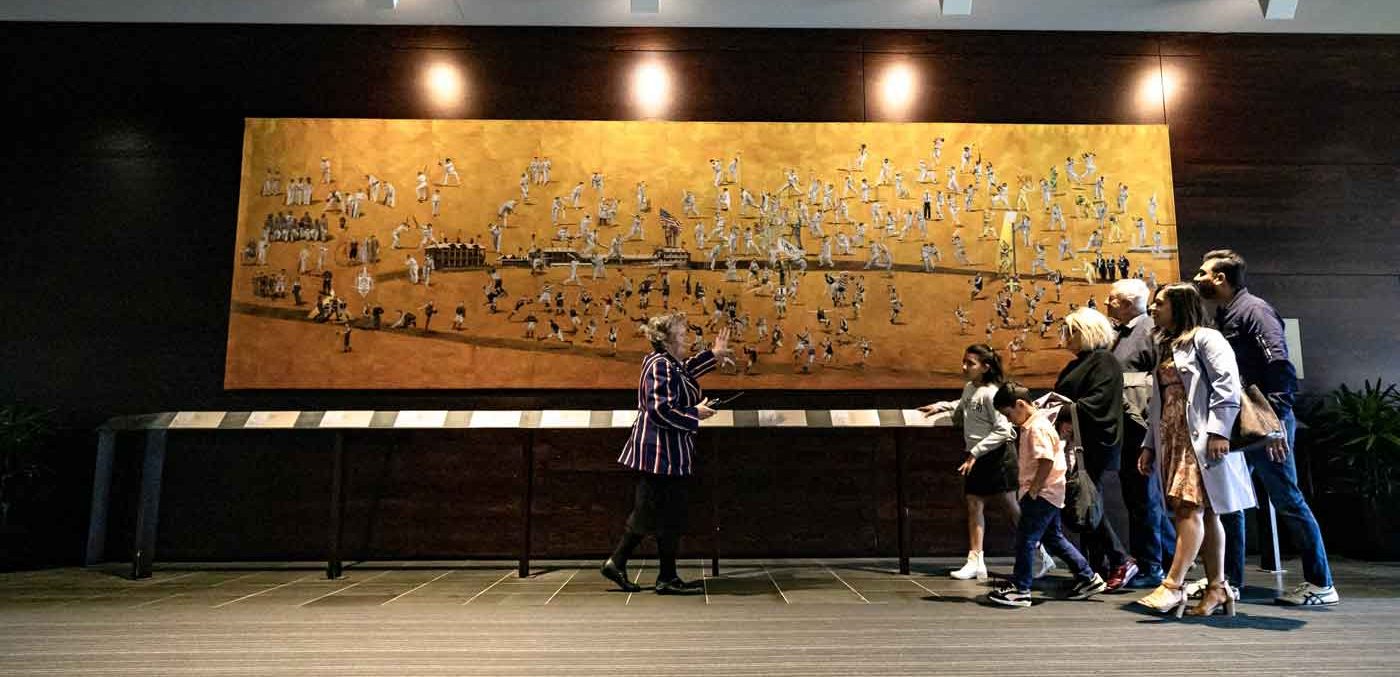
Visitors to Keating’s hometown of Melbourne are quite likely to encounter his art in the streets – for instance, there are epic murals in a Chinatown vacant block and on a huge Swanston Street construction site roller door, exemplifying the ‘medicinal’ approach to colour the artist touches upon above. However, Keating says he gets a substantial amount of feedback as a result of the commission he completed for the 80th storey entrance lobby to Melbourne’s Ritz-Carlton hotel.
“It’s been a great experience, having a piece of my work on display at the Ritz-Carlton,” Keating says. “It’s really special because it’s one of the few works I have that’s on view 24/7, and it’s intimately experienced by so many people.” Keating is amazed by how many guests from the hotel have reached out to express their admiration for his art. “They often get in touch, ask about my work, and even want to visit my studio. That’s been a lovely surprise.”
Keating explains, “The work in the streets doesn’t always lead to direct engagement like that, but with this type of environment, people are often in a more relaxed state and more open to the beauty of the art around them.” He says he’s open to more of these types of opportunities, showcasing his work outside the conventional confines of a gallery – or the ephemeral siting of city walls. “There’s something very rewarding about creating a nuanced and intense work in the studio and then seeing it displayed in such a setting, where it can be appreciated by a lot of people, over an extended period of time.”